
Journal · Comparisons & Stack
The 2026 Shopify returns stack compared: RMA portals vs. payout connectors vs. Return Owl
Return portals handle shipping labels, and payout connectors summarize bank deposits. Neither checks whether closed returns were actually paid or restocked. Here is how the five categories of Shopify return tools compare and fit together.
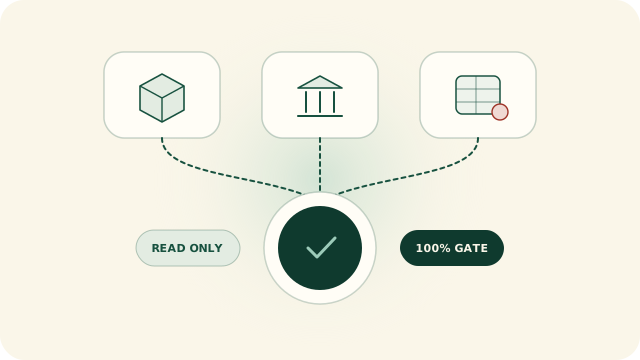
At a glance · RMA Portals · Payout Connectors · Helpdesks · Native Reports
- Customer return portals (Loop, ReturnGO, AfterShip) automate labels and exchange intake, but do not audit whether gateway refunds failed or whether returned inventory re-entered Shopify stock.
- Accounting payout connectors (A2X, Synder) reconcile settled bank deposits to QuickBooks or Xero, which means unrefunded returns and failed refunds never appear in their journals.
- Return Owl sits alongside your existing stack ($9–$49/mo after a free 60-day audit) to verify every order, classify expected workflows, and hand your bookkeeper a 100%-coverage Accountant Pack.
Why stores with $500/month in return software still lose money in Excel
Talk to an apparel, footwear, or home brand doing 1,500 orders a month on Shopify and you will usually find a mature software stack: a customer-facing return portal for RMA labels, a helpdesk for buyer tickets, a 3PL or warehouse integration for receiving, and an accounting connector that pushes payout summaries into QuickBooks or Xero. Yet on the first Monday of every month, the founder or bookkeeper is still exporting CSVs into a spreadsheet trying to figure out why refunds, returns, and inventory do not tie out.
The problem is not that those tools are broken. The problem is that each tool category only sees its own slice of the transaction — and assumes the next system in line finished the job.
How the four layers of Shopify returns software divide responsibility
Head-to-head: the 5 tool categories high-return Shopify brands evaluate
When evaluating software for a high-return Shopify store, buyers often confuse workflow automation with financial reconciliation. Here is what each category actually solves — and the blind spot it leaves behind:
| Software category | Primary job it does well | What it misses (the blind spot) | How Return Owl extends it |
|---|---|---|---|
| 1. Customer RMA Portals (e.g., Loop, ReturnGO, AfterShip, Redo) | Self-serve return labels, size exchanges, and bonus store-credit offers for shoppers | Once it triggers a Shopify action or closes an RMA, it does not audit silent gateway errors, 3PL restock misses, or prorated line discrepancies | Reads the resulting Shopify order, return, and refund records to verify the money and stock actually settled |
| 2. Accounting Payout Connectors (e.g., A2X, Synder, QuickBooks/Xero sync) | Summarizes settled Shopify Payments and PayPal payouts into balanced GL journal entries | Only sees money that already moved. Unrefunded closed returns, failed refunds, and un-restocked inventory are invisible to payout feeds | Catches the unpaid and un-restocked exceptions before close and exports an order-level Accountant Pack |
| 3. Customer Helpdesks (e.g., Gorgias, Zendesk, Gladly) | Fast ticket responses and one-click order actions for support agents | Agents issue instant refunds or re-click failed refunds without seeing whether a prior retry already succeeded or whether the warehouse received the item | Suppresses stale failures when a retry succeeds and flags refunded lines whose return processing or restock never finished |
| 4. Native Shopify Analytics & CSVs | Free store-level return rate trends and date-filtered sales summaries | Mixes exchanges, store credit, keep-it policies, and real money leaks together; no order-level exception queue or coverage gate | Separates NEEDS_ATTENTION money leaks from EXPECTED workflows and DATA_INTEGRITY anomalies automatically |
| 5. Return Owl (Read-Only Reconciliation Layer) | Finds failed refunds, returns never refunded, and refunds never restocked with accountant-grade evidence | Intentionally never prints shipping labels, never talks to customers, and never writes mutations to Shopify | Acts as the independent, read-only audit layer across your portal, 3PL, helpdesk, and bookkeeper |
Why adding a $19/month verification layer beats switching portals
Many merchants assume that if their books do not reconcile, they need to migrate to a more expensive enterprise return portal. In reality, switching customer portals takes weeks of theme work and warehouse retraining — and still leaves your bookkeeper without an order-level reconciliation pack at month-end.
Keep your existing RMA portal
Let your portal handle buyer labels and exchanges. Return Owl automatically classifies those exchanges and store-credit refunds as EXPECTED so they never clutter your exception queue.
Give your bookkeeper order-level proof
Pair your payout connector with Return Owl’s Accountant Pack (CSV on Growth at $19/mo, PDF on Scale at $49/mo) so accrued liabilities and restock recovery are tied to exact Shopify orders.
Zero implementation risk
Because Return Owl uses strictly read-only Shopify scopes and requests zero customer PII, installing the free 60-day audit cannot break a checkout, theme, or warehouse webhook.
Pay for store scale, not return punishment
Flat monthly tiers ($9 / $19 / $49) based on distinct UTC orders mean a high-return month never inflates your software bill.