
Journal · Store Scenarios
When the 3PL closes the return but nobody pays the customer: fixing the warehouse-to-finance handoff
The warehouse marks the return closed because the box arrived. Support closed the ticket last week when the label went out. Four days later, the customer still hasn’t been paid. Here is how to close the handoff gap.
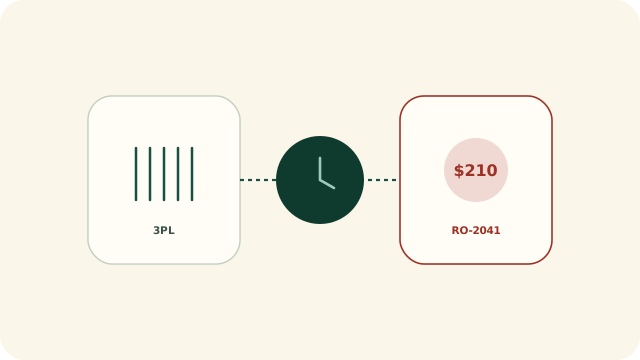
At a glance · 3PL / WMS Integrations · Split Ops & Support Teams
- Outsourcing fulfillment to a 3PL or splitting warehouse receiving from customer support creates a classic handoff blind spot: the warehouse closes the return record, but no refund transaction fires.
- Return Owl waits 72 hours after return closure or creation before flagging unpaid refundable value, giving normal inspection and settlement workflows time to finish.
- Exchanges, store credit, instant refunds, and cancellation fees are classified as EXPECTED from positive evidence, while prorated line math catches partial or over-refund errors.
Why scaling from founder-fulfilled to a 3PL breaks return settlement
When a small store fulfills from its own back room, the person who opens the returned box is usually the same person who clicks “Refund” in Shopify Admin. As soon as order volume passes 500 orders a month and fulfillment moves to a third-party logistics (3PL) warehouse, that single motion splits into two separate departments.
The 3PL’s warehouse management system (WMS) scans the incoming barcode, grades the garment, and updates the Shopify return status to Closed / Processed. If the order had a manual review hold, a split shipment, a discount code, or a webhook hiccup in the RMA tool, the automatic refund trigger silently skips the order. The warehouse thinks its job is done; customer support thinks the automation paid the buyer.
The 72-hour safety net between warehouse closure and customer dispute
Bidirectional protection: catching refunds where the return never finished
The handoff fails in the reverse direction too. Customer support frequently issues a manual refund to appease a VIP customer while the return is still open — and then the return record sits half-processed forever, or the refund amount exceeds the prorated return-line value. Return Owl checks all three return-line vectors:
| Check name | What went wrong in the handoff | Threshold & severity | Expected workflows excluded |
|---|---|---|---|
| Return processed, refund outstanding | Warehouse processed the return line with refundable value, but $0 refund is recorded | 72 hours after return closed or created · High severity when closed | Exchanges (EXCHANGE), store credit (STORE_CREDIT), keep-it policies, approved patterns |
| Refund complete, return processing outstanding | Line was refunded beyond what the warehouse processed on the return | 72 hours after return closed or created · Medium severity | Instant refunds and refund-before-receipt workflows (INSTANT_REFUND / REFUND_BEFORE_RECEIPT) |
| Refund amount discrepancy | Actual successful refund differs from the prorated return-line value (over- or under-refund) | Immediate · Medium severity (outranks refund-owed when over-refunded) | Documented cancellation or restocking fee policies (CANCELLATION_FEE) |
How operations teams close the loop in under two minutes per case
When Case RO-2041 lands in the Needs attention queue (or triggers an instant high-severity email alert), the operations manager does not have to hunt through 3PL spreadsheets. The case dossier displays the exact return line, the 94-hour age, the $210.00 refundable value, and a fix-next checklist that opens Order #1018 and Return #318 directly in Shopify Admin. Once handled in Shopify, staff record the outcome (`Handled in Shopify` or `Refund verified successful`) and the case moves out of open risk.